Best OHIP Billing Software in Ontario: 2026 Comparison
Every way to bill OHIP in Ontario, compared on published pricing, caps, claim review, rejection handling, mobile apps and EMR fit: Dr. Bill, CAB.md, IntelAGENT, MedConcierge, ClinicAid, Tali, DoctorCare, EMR billing, billing agents and SnapBill.

SnapBill Team
OHIP Billing Experts
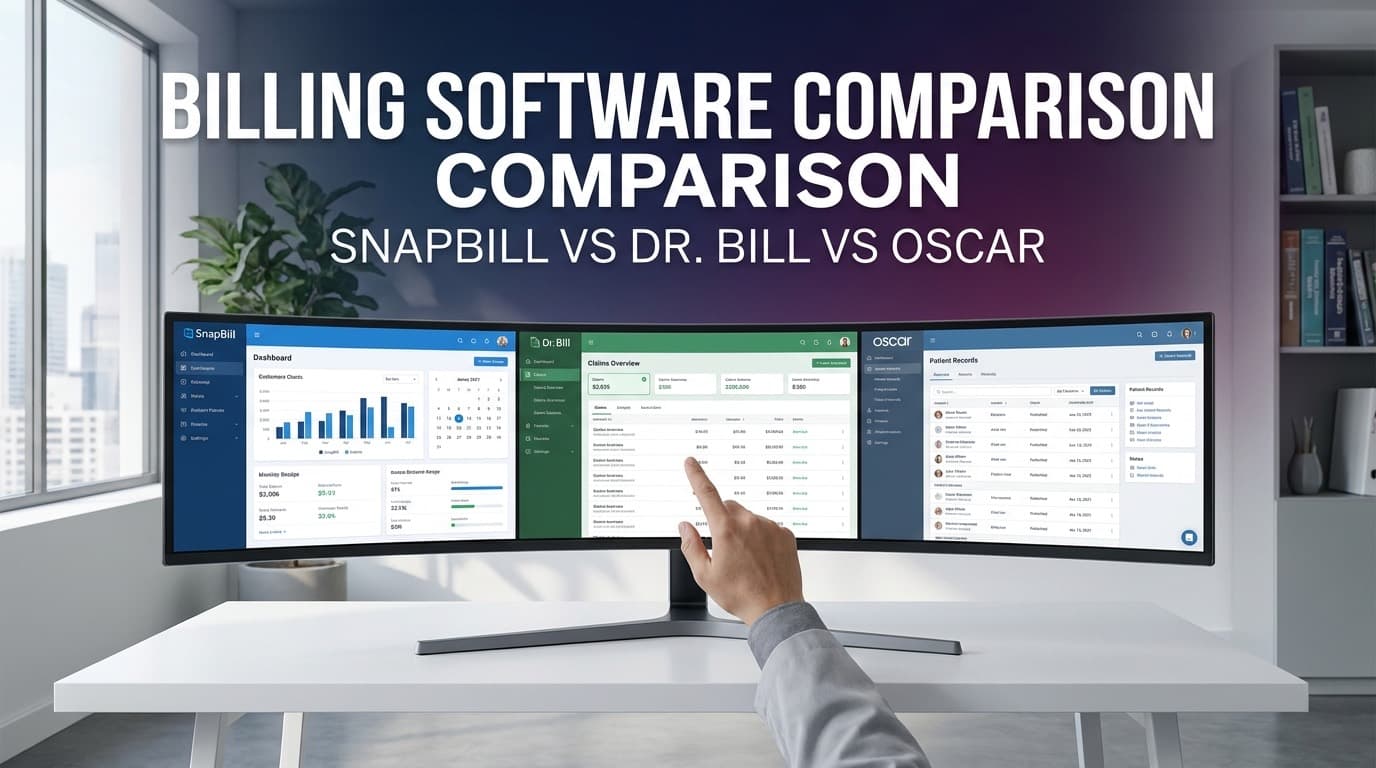
Best OHIP Billing Software in Ontario: 2026 Comparison
Every Ontario physician billing fee-for-service or shadow billing needs something that turns services into claims, submits them to the Ministry of Health through MCEDT, and reconciles what comes back. In 2026 there are more ways to do that than ever: self-serve apps, full-service plans with billing agents, EMR billing modules, point-of-care tools and outsourced agencies.
This guide covers every option an Ontario physician is realistically choosing between, with each vendor's published pricing as of October 2026, linked to its source. SnapBill publishes this page and is one of the vendors listed. We have tried to describe every competitor the way its own website does, and where a price is not published we say so instead of guessing.
How to choose OHIP billing software
Eight questions separate the options more than any feature list does.
1. Self-serve or agent-reviewed? Self-serve plans give you software; you enter claims, read your error reports and fix rejections. Agent-reviewed (full-service) plans add people who review claims, correct rejections and handle appeals. The rate difference is large: roughly 0.25% versus 1.5% to 2% of paid claims.
2. Percentage, capped percentage, or flat fee? Most vendors charge a percentage of paid claims. Some cap it per month; one charges a flat fee; one prices by claim volume. The cap matters more than the headline rate once you bill more than about $200,000 a year.
3. Is there a monthly cap? Two plans with the same 0.25% rate can differ by hundreds of dollars a year depending on whether the fee stops at $40 a month.
4. Does it submit directly as your MCEDT designee? Direct submission means the platform uploads claims and downloads your batch edit reports, error reports and Remittance Advice for you. If you are new to the system, start with what MCEDT is and how designees work.
5. Does it check claims before submission? Catching a missing diagnostic code, an expired health card or a code combination the Schedule of Benefits does not allow before the claim goes out is cheaper than fixing a rejection two weeks later. Ask what is checked automatically, and what only a paid agent checks.
6. What happens when a claim is rejected? On self-serve plans you usually correct it yourself. Know what the error codes mean (OHIP rejection codes explained) and whether the platform matches every rejection back to the original claim.
7. Does it fit your EMR? Clinics charting in Accuro, TELUS PS Suite, CHR, Med Access or OSCAR Pro may prefer to bill inside the chart. Hospital-based and ED physicians often do not have an EMR billing workflow at all and bill from lists, stickers or day sheets.
8. Contract, lock-in and history. Check for contracts, setup fees and cancellation terms, and whether you can export your billing history and import it elsewhere. Our guide to switching billing platforms covers the mechanics.
Comparison table: every Ontario OHIP billing option
Rates are as published by each vendor on October 22, 2026, before HST unless noted. Follow the links in each vendor section for the source.
| Vendor and plan | Pricing model | Published rate | Monthly cap | Claim checks / review before submission | Rejection handling | Mobile | EMR |
|---|---|---|---|---|---|---|---|
| SnapBill Essentials | % of paid claims | 0.2% | $34.99 + HST | Every claim checked against the Schedule of Benefits; health card validation | Automatic RA reconciliation; you correct and resubmit | iOS & Android | Standalone; history import by CSV |
| SnapBill Premium | % of paid claims | 1.5% | None | As Essentials, plus claim review before submission | Corrected by the SnapBill team | iOS & Android | Standalone |
| Dr. Bill Essentials | % of paid claims | 0.25% | None | Proactive error detection, code suggestions | Self-serve; billing agent at $50/hour | iOS & Android | Custom integrations on Group plans |
| Dr. Bill Comprehensive | % of paid claims | 1.95% | None | Claim optimization consulting | Automatic rejection recovery by agents | iOS & Android | As above |
| CAB.md Self Service | Flat fee | $40/month | Flat | Automated error highlighting, billing opportunities | Self-serve | iOS & Android | Built-in scheduler |
| CAB.md Full Service | % of paid claims | 1.95% | None | Expert claim entry and auditing | Correction of rejected claims | iOS & Android | Built-in scheduler |
| IntelAGENT Self-Service | % of paid claims | 0.25% | $39.99 | Error detection, code suggestions | Self-serve | iOS & Android | Enterprise EMR integration (contact sales) |
| IntelAGENT Premium | % of paid claims | 2% | None | Billing agent reviews all claims | Rejection management and appeals | iOS & Android | As above |
| MedConcierge | % of paid claims | 0.25% | $40 + HST | Pre-submission error checks, health card validation | In-app resubmit, RAI and document upload; self-serve | Web only (no app listed) | Not listed |
| ClinicAid | Flat fee by claim volume | $27 to $179/month | By tier | Health number validation, billing logic | Self-serve; error correction add-on $150/month | Web and mobile | API integrations |
| Tali | Not published | Not published | n/a | Code recommendations from the visit note, checked against patient history | RA analysis dashboard | Within Tali | Accuro, PS Suite, CHR, Med Access and others |
| DoctorCare | Managed service | Not published | n/a | Agents review and submit claims | Agents fix and resubmit | Physician portal | Works with OSCAR, Accuro, TELUS |
| EMR built-in billing | Part of EMR licence | Not published | n/a | Basic rules | Manual | Varies | Native |
| Billing agencies | Usually % of billings | Varies | Usually none | Agent enters and reviews | Agent corrects | Varies | Varies |
What it costs: worked example
Billing software is usually priced on paid claims, so the same plan costs very different amounts at different volumes. This table assumes billings spread evenly across the year (caps apply per month), excludes HST and excludes discounts such as Dr. Bill's RBC client pricing.
| Plan | $200,000/year paid claims | $500,000/year paid claims |
|---|---|---|
| SnapBill Essentials (0.2%, cap $34.99) | $400 | $419.88 |
| IntelAGENT Self-Service (0.25%, cap $39.99) | $479.88 | $479.88 |
| MedConcierge (0.25%, cap $40) | $480 | $480 |
| CAB.md Self Service ($40 flat) | $480 | $480 |
| Dr. Bill Essentials (0.25%, no cap) | $500 | $1,250 |
| SnapBill Premium (1.5%) | $3,000 | $7,500 |
| Dr. Bill Comprehensive (1.95%) | $3,900 | $9,750 |
| CAB.md Full Service (1.95%) | $3,900 | $9,750 |
| IntelAGENT Premium (2%) | $4,000 | $10,000 |
Two things stand out. Among capped self-serve plans, prices sit within about $80 a year of each other, so features should decide. And the choice of tier matters far more than the choice of vendor: full-service plans cost roughly 7 to 24 times what self-serve plans cost, which is worth it only if you will use the agent review and rejection work you are paying for.
ClinicAid is not in the table because it prices by claim count rather than dollars: a physician submitting 400 claim lines a month would be on the Standard tier at $99/month, or $1,188 a year.
SnapBill
SnapBill is an OHIP billing platform built by physicians for Ontario fee-for-service billing. It launched in 2026.
Pricing: Essentials is 0.2% of paid claims, capped at $34.99/month + HST. Premium is 1.5% of paid claims and adds claim review before submission and rejection correction by the SnapBill team. New physicians get 3 months of Premium free, starting when their billing number is activated rather than at sign-up. New Ontario graduates also get months 4 to 6 at 0.75% (new grad offer).
Strengths:
- Snap: one photo of an entire patient list or day sheet becomes claims. This is the main workflow difference from other mobile apps, most of which read one patient label or health card per photo.
- Every claim is checked against the Schedule of Benefits before submission (diagnostic code requirements, code combinations, service limits), with health card validation.
- Direct MCEDT submission as your designee, with automatic Remittance Advice reconciliation.
- Group and ED billing for departments and physician groups (SnapBill for groups).
- A free public page for every OHIP code, with fees and billing rules, at snapbill.ca/billing-codes.
- iOS and Android apps.
Weaknesses:
- Launched in 2026, so it has a much smaller user base and a shorter track record than vendors that have billed OHIP for a decade.
- Standalone; it is not a module inside your EMR. Billing history from another platform imports by CSV.
Best for: physicians billing from lists, stickers or day sheets (hospitalists, ED, inpatient consults) and anyone who wants claims checked against the Schedule before they go out. See the detailed SnapBill vs Dr. Bill comparison.
Dr. Bill (RBC)
Dr. Bill is owned by RBC and is the largest billing platform in the market; its pricing page says it is trusted by over 13,000 physicians. RBC is consolidating MDBilling.ca into Dr. Bill: mdbilling.ca now redirects to dr-bill.ca.
Pricing (source): Essentials is 0.25% of paid claims per billing cycle, with no monthly cap. Comprehensive is 1.95% of paid claims and adds billing agent support, claim optimization consulting and automatic rejection recovery. Group Solutions are custom priced. Essentials users can hire Dr. Bill's agents at $50/hour for rejections, reconciliation and appeals. New clients get the first 2 months of Comprehensive waived. RBC clients are offered 23% to 48% off depending on plan and banking relationship.
Strengths: the longest track record and largest user base; more than 60 specialties served; covers OHIP, BC and Alberta; out-of-province claims; human billing agents on Comprehensive; LabelSnap photographs a patient label or health card to fill in patient details.
Weaknesses: no monthly cap on Essentials, so cost keeps rising with billings; the free period applies to Comprehensive, and changing plans during it ends the offer; label capture reads one patient per photo, so claim details are entered one at a time.
Best for: physicians who want an established vendor with agent support, especially RBC clients who qualify for the discount.
CAB.md (CabMD)
CabMD, from Clinical Support Systems, has been in the market for over a decade and reports over 8,500 physicians submitting more than $105 million in claims a month.
Pricing (source): Self Service is a flat $40/month per physician with unlimited OHIP and non-OHIP claims, a 60-day free trial and no activation or annual fees. Full Service, through its billing agent partner, is 1.95% of paid claims and includes claim entry, correction of rejected claims, reconciliation and auditing.
Strengths: predictable flat price; built-in scheduler and appointment list; inpatient roster with a wizard for billing a whole hospital stay; mobile apps that fill patient details from hospital stickers or health cards.
Weaknesses: a flat fee costs the same $40 in a light month as a busy one; the interface is older than newer entrants.
Best for: full-time physicians who want a fixed monthly cost and a scheduler in the same tool.
IntelAGENT
IntelAGENT has billed OHIP since 2016 and its comparison page cites 2,000+ physicians and $1B+ in processed claims.
Pricing (source): Self-Service is 0.25% of paid claims, capped at $39.99/month. Premium is 2% of paid claims with a dedicated billing agent who reviews all claims before submission, handles rejections and appeals, and offers monthly consultations. Both include a 3-month free trial with no contract. Clinic and hospital department plans with EMR integration are quoted.
Strengths: capped self-serve pricing; bulk upload by spreadsheet; billing analytics against similar physicians; RAI and eSubmit; dedicated departments and groups offering (AFA, academic, ED).
Weaknesses: Premium is the highest published full-service rate in this comparison at 2%.
Best for: physicians who want capped self-serve pricing from an established vendor, or a dedicated agent and are comfortable with 2%.
MedConcierge
MedConcierge is a mid-2026 entrant, designed by an Ontario physician.
Pricing (source): Self Billing is 0.25% of paid claims, capped at $40/month + HST, with 3 months free and no invoice until the ministry starts paying claims through it.
Strengths: pre-submission error checks and health card validation; rejections handled in the app (resubmit, RAI inquiries, document upload to MCEDT) without a separate MCEDT login; IFH claim assist; day sheet upload and bulk billing.
Weaknesses: new, like SnapBill; no native mobile app is listed on its site; no full-service or agent tier is published.
Best for: self-serve physicians who want in-app rejection tools and capped pricing.
ClinicAid
ClinicAid, a WELLSTAR company, is a cloud billing platform for providers, groups and billing agents across several provinces.
Pricing (source): monthly tiers by claim lines: Mini $27 (up to 100), Basic $49 (up to 250), Standard $99 (up to 700), High $179 (up to 1,500), custom above that, with $0.34 per line over your limit. An error correction service is $150/month per physician. No setup fees or contracts.
Strengths: pricing independent of dollar volume, which suits high-fee specialists with few claim lines; multi-user access suited to clinics and billing staff; APIs for integration.
Weaknesses: high-volume, low-fee practices can pay more than on a capped percentage plan; error correction is a separate fee.
Best for: clinics and billing agents managing several providers, and specialists with high-value, low-count claims.
Tali
Tali is an ambient scribe company that has added an OHIP billing agent for Ontario primary care. It suggests billing and diagnostic codes from the visit note, checks frequency rules against patient history, submits through MCEDT once the clinician approves, and analyses the Remittance Advice. Tali describes this in its own billing comparison and on its billing page.
Pricing: not published for billing. Tali's pricing page lists scribe plans only.
Strengths: billing tied to documentation; FHO+ time tracking; integrations with Accuro, PS Suite, CHR, Med Access and others.
Weaknesses: focused on primary care clinics; billing pricing not public; most useful if you also use Tali for notes.
Best for: FHO and FHO+ primary care clinics already using or considering Tali as their scribe.
DoctorCare
DoctorCare is a managed billing and practice-optimization service. Its Billing Care service reviews and submits claims from your EMR and fixes and resubmits errors; it works with OSCAR, Accuro, TELUS and others. It also offers roster management, outside-use reporting and bonus optimization for FHO practices, plus hospital and group billing services.
Pricing: not published; DoctorCare starts with a free assessment.
Best for: FHO and group practices that want people to manage billing, roster and bonus work, not new software.
EMR built-in billing (Accuro, TELUS PS Suite and CHR, Med Access, OSCAR Pro)
Most Ontario EMRs include an OHIP billing module, so claims are created next to the chart. In Accuro, claims are built from the appointment and reconciled in a claims workspace. In TELUS CHR, Ontario billing has run through an integration with MDBilling, which is now part of Dr. Bill. PS Suite and Med Access bill from the encounter. OSCAR Pro includes billing in the EMR.
Pricing: bundled with the EMR licence; none of these vendors publishes a separate billing price.
Strengths: no second system; billing staff already know it.
Weaknesses: code entry is manual, checks are basic, and rejected claims and unmatched remittance lines are reconciled by hand. Many clinics add an agent or a service such as DoctorCare on top.
Best for: clinics where billing staff work inside the EMR all day.
Billing agencies (agent services)
Independent billing agents enter, submit and reconcile claims for you as your MCEDT designee. Pricing is quoted per physician and is usually a percentage of billings; the full-service tiers above (1.5% to 2%) are a useful benchmark. Ask who reviews your claims, how quickly rejections are corrected, whether you can see your claims and RAs yourself, and how you get your data back if you leave.
Best for: physicians who want billing off their plate entirely and accept a higher percentage for it.
Which OHIP billing software is best for...
New graduates. Choose a platform you can learn on, with a long free period. SnapBill's 3 months of Premium start when your billing number is activated, so the free time is not used up while you wait for the ministry, and new grads get months 4 to 6 at 0.75% (new grad offer). IntelAGENT and MedConcierge offer 3 months; Dr. Bill offers 2 months of Comprehensive. If you are still learning how claims work, read OHIP billing basics for new physicians first.
ED groups and hospital departments. Look for group billing, shift-based workflows and claim entry from lists. SnapBill (groups), IntelAGENT (departments and groups), Dr. Bill (Group Solutions) and DoctorCare (hospital and group billing) all have group offerings. Group pricing is quoted rather than published by most vendors, so ask each for a written quote and compare it against the solo rates above.
Specialists. High-fee codes make uncapped percentages expensive. A capped plan (SnapBill Essentials, IntelAGENT Self-Service, MedConcierge), a flat fee (CAB.md) or claim-volume pricing (ClinicAid) keeps cost predictable. Check that the platform handles your specialty's premiums, time-based codes and referring physician requirements; you can look up any code's rules on the OHIP billing code pages.
Clinics on an EMR. Start with your EMR's own billing module, and add DoctorCare or Tali if you want review or code suggestions inside the chart. Standalone apps suit physicians in the clinic who also bill hospital work separately.
Part-time and locum physicians. Percentage-of-paid-claims pricing costs nothing in months you do not bill. A flat fee keeps charging unless you cancel. Dr. Bill states that accounts stay active at no cost when you are not billing; on SnapBill, a month with no paid claims has no commission.
Switching from your current platform
Switching is mostly paperwork. Export your billing history, import it into the new platform, and change your MCEDT designee so new claims go through the new service. Claims already submitted through your old platform are still paid by OHIP. Plan the switch between submission cycles so nothing is submitted twice. The full checklist is in switching billing platforms, and the Dr. Bill specifics are on the SnapBill vs Dr. Bill page.
How this comparison was made
- Date: every competitor price was read from the vendor's own website on October 22, 2026, and is linked. Vendors change pricing; check the source before you sign up.
- Rates: compared as published, before HST, excluding promotions and bank or referral discounts. Where a vendor states its fee is on paid claims, we say so.
- Costs: worked examples assume billings are spread evenly across 12 months, because caps apply per month.
- Features: described from each vendor's public pages. Where a capability could not be confirmed, the table says "not listed" or "not published", which does not mean it is absent.
- Disclosure: SnapBill publishes this page and is one of the vendors compared. If any detail about another vendor is out of date, email hello@snapbill.ca and we will correct it.
Want to see your own claims checked against the Schedule of Benefits before they go out? Start SnapBill free: 3 months of Premium from billing-number activation, no credit card.
Frequently asked questions
- What is the best OHIP billing software?
- It depends on how much of the work you want to keep. For self-serve billing, Dr. Bill, CAB.md, IntelAGENT, MedConcierge, ClinicAid and SnapBill all submit directly through MCEDT; they differ on caps, claim checks and how claims get entered. If you want someone else to review claims and fix rejections, compare the full-service tiers (Dr. Bill Comprehensive, IntelAGENT Premium, CAB.md Full Service, SnapBill Premium) or an agency like DoctorCare.
- How much does OHIP billing software cost?
- As of October 2026, self-serve plans run 0.2% to 0.25% of paid claims, with most capped at about $35 to $40 a month, or a flat $27 to $179 a month based on claim volume. Full-service plans with a billing agent run 1.5% to 2% of paid claims. Dr. Bill Essentials (0.25%) is the main self-serve plan with no monthly cap.
- Is there free OHIP billing software?
- No major cloud billing service is free on an ongoing basis, but most offer a free period: SnapBill gives 3 months of Premium from billing-number activation, IntelAGENT and MedConcierge offer 3 months, Dr. Bill waives 2 months on Comprehensive and CAB.md offers 60 days. Open-source EMRs such as OSCAR include billing but need paid hosting and support.
- Can I submit OHIP claims without billing software?
- Technically yes: the Ministry of Health accepts claim files uploaded through MCEDT. In practice the file has to follow the ministry fixed-width claim format exactly, so almost every physician uses billing software, an EMR billing module or a billing agent to create and submit it.
- How do I switch from Dr. Bill?
- Export your billing history from Dr. Bill as a CSV, import it into the new platform, then make the new platform your MCEDT designee so new claims submit through it. Claims you already submitted through Dr. Bill are still paid by OHIP as normal.
- Should I pay a percentage of claims or a flat monthly fee?
- A percentage of paid claims costs nothing in months you do not bill, which suits locums and part-time physicians. A capped percentage or a flat fee is more predictable for full-time billers. Above roughly $200,000 a year in billings, an uncapped percentage costs noticeably more than a capped plan.
- What is an MCEDT designee?
- MCEDT is the Ministry of Health service that receives claim files and returns batch edit reports, error reports and Remittance Advice. Making a billing platform your designee lets it submit claims and download those reports on your behalf, without you logging in to GO Secure.
Ready to simplify your OHIP billing?
Join Ontario physicians who bill smarter with SnapBill. No setup fees, no monthly minimums.
Get Started Free